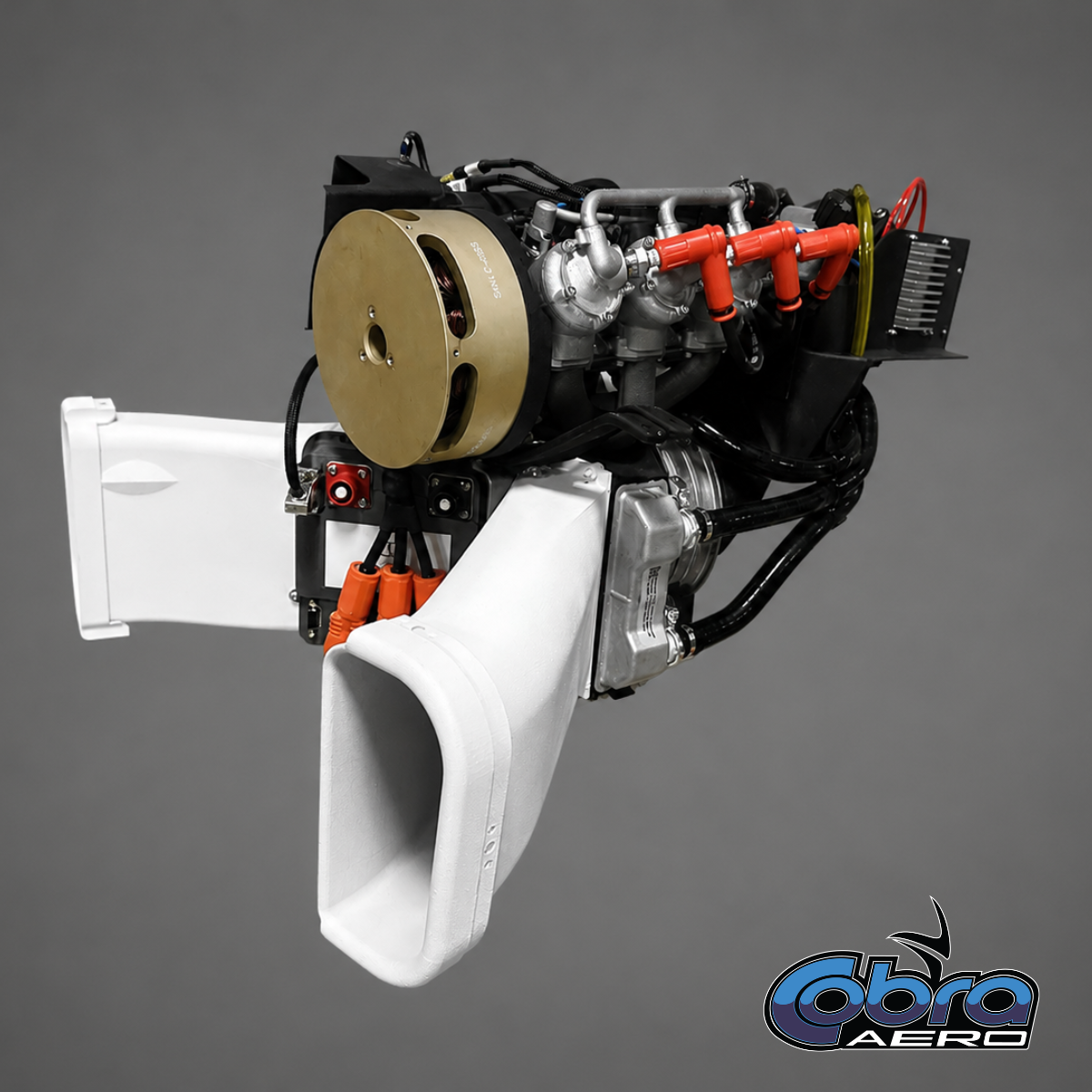
New Electric Power Unit delivers 9 kW of electric power at 120V in a compact, liquid-cooled package designed for austere operating environments
Cobra AERO and PteroDynamics recently announced an agreement to jointly develop a series hybrid-electric propulsion system configured specifically for PteroDynamics’ autonomous P5 Transwing® VTOL unmanned aircraft system. Centered on Cobra AERO’s new A99HF-EPU (Electric Power Unit), the system is designed to provide reliable onboard electrical power in demanding mission profiles while packaging neatly inside the aircraft fuselage.
The A99HF-EPU is a compact, liquid-cooled hybrid-electric power generation unit that produces 9 kW of electrical power and operates at 120V. Its thermal management approach is intended to support sustained performance in hot, high, and otherwise austere environments where traditional air-cooled solutions can be constrained. Furthermore, the A99HF straight-triple cylinder architecture provides smooth operation, compact packaging, world-class durability, and excellent power density. The system can operate on a wide variety of military and civilian fuel options.
“Cobra AERO is excited to work with the PteroDynamics team in providing reliable, fuel-efficient electric power with low thermal and acoustic signatures for the P5. The A99HF-EPU will not only power this unique aircraft, but it will also power payloads, avionics, and communications.” ~Sean Hilbert, President at Cobra AERO
P5 Airframe and Hybrid-Electric Integration
The P5 aircraft is purpose-built for a series hybrid-electric propulsion architecture. Its patented Transwing design uses a distributed array of propellers to provide both lift and thrust, enabling the propulsion system to be optimized around efficient operating points.
Higher system efficiency: The P5 supports downsizing the prime mover and operating the hybrid system at its most efficient points. This is enabled by the EPU’s series hybrid topology.
Low drag with expeditionary capability: Transwing minimizes airframe drag while maintaining runway-independent, expeditionary operations.
Flexible EPU placement: Because propulsion is distributed, EPU integration is not constrained by propeller location, optimizing airframe packaging.
High durability: Minimal vibration, liquid cooling, and low mean piston speeds translate into 500-hour minimum TBO target today with a pathway to 1000-hours.
Configuration: Straight triple two-stroke ICE with direct drive generator
Output: 9 kW electrical power
Fuel Efficiency: 600g/kWe-hr. A strong starting point with a technical road map (though generator, GCU, and combustion efficiency improvements) to reduce specific fuel consumption by at least another 35%.
Bus voltage: 120V
Cooling: Liquid-cooled for harsh environments and reduced airframe drag
Integration: Configured for PteroDynamics P5 with internal fuselage packaging
Hybrid approach: Series hybrid-electric propulsion system development
“Cobra AERO has been a key member of the P5 development team in advancing the aircraft’s hybrid-electric propulsion system. The A99HF-EPU provides a reliable, low-SWaP, heavy-fuel power solution that enhances the Transwing platform’s reliability, operational flexibility, and expeditionary capability. This partnership supports the development of a next-generation autonomous logistics capability for contested maritime environments. “ ~Thomas Lewis, Lead System Engineer at PteroDynamics
The development effort brings together a team of established partners. Flighthouse Engineering conducted much of the initial airframe and propulsion system sizing analysis, AllocorTech supplied the Generator Control Unit (GCU), and Power4Flight—Cobra AERO’s longtime collaborator for more than a decade—contributed to the engine and hybrid-electric system controls that underpin the EPU architecture, and ePropelled will supply both the generator and the propeller drives.
Engineering activities are underway, with the team focused on system integration, controls validation, and test planning for P5 flight demonstration activities. The team will begin flying this platform in Q4 of 2026.